Blog

DOCUMENT CONTROLLING PROCEDURE

Documentation relating to all project activity is prepared and maintained by
each organizational element. Such documentation will provide accurate and
current information on all project activities and for all information which contributes to the understanding of the project. Records are reviewed by appropriate personnel and provided to all concerned organizational elements. Procedure for documentation and record maintenance and retention are given as below:

1. SUMMARY
1.1. This procedure defines the requirements for the creation, review, approval, distribution, use and revision of quality management system documents.
1.2. This procedure applies only to documents which instruct office/site staff on how to carry out activities and tasks; this includes manuals, procedures, forms and instructional sheets or posters.
2. PROCEDURE
2.1. Creation of Documents
2.1.1. Documents are created by an appropriate subject matter expert.
2.1.2. All internal documents are created as soft files (MS Word®, etc.); it is recommended that files of a similar type follow the format of other documents in that type.
2.1.3. Draft versions must then be sent to the appropriate approver(s) for review and approval.
2.1.4. Original releases of documents are given a revision indicator of “0”.
2.2. Review and Approval
2.2.1. The Quality Manual may only be approved by the senior Management. Other documents are to be approved by the original author, or a company executive.
2.2.2. Draft files may be sent to the approver(s) via hard copy or e-mail.
2.2.3. The reviewer will resolve any issues with the original author to achieve a satisfactory document.
2.2.4. The reviewer will indicate approval of the document by e-mail.
2.2.5. The approved document shall then be forwarded to the Document Controller .
2.2.6. If hard copy binder will be used , document Controller , will maintain a binder of most current hard copy versions of documents.
2.2.7. The Document Controller will maintain a computer folder, on the company server, for the latest soft copy versions of document with backup facility. The Document Controller Title will place new or revised documents into that folder, Any previous soft versions are then moved to a separate folder identified for obsolete documents which are kept for historical purposes.
2.2.8. The directory of official released documents shall act as a “master list” of documents, indicating the setting each file’s permission to READ ONLY, or converting the released versions to a non-editable file format.
2.2.9. current versions of all documents. No other master list is required.
2.3. Distribution of Documents
2.3.1. If intranet is used, Controlled documents will be available via the intranet for all employees.
2.3.2. If hardcopy document distribution is used, the Document Controller will maintain a list of where controlled hardcopy documents are to be distributed. The Document Controller will be responsible for distributing updated copies of such controlled hardcopies to proper locations. Controlled hardcopies shall be marked with stamp in color ink on the first page as CONTROLLED, to distinguish them from uncontrolled documents or photocopies.
2.3.3. Controlled hardcopies may not be altered or modified by users, and must remain legible and readily identifiable. This includes hand mark-ups by unauthorized personnel. Controlled hardcopies may not be photocopied, unless for the purposes of sending to a recipient who is authorized to receive uncontrolled versions of Project documents (i.e., a vendor or customer).
2.4. Re-Evaluation
2.4.1. Documents must be reviewed by the original author or another subject matter expert or top manager as required.
2.4.2. The Document Controller will ensure re-evaluation is conducted and that documents are updated if required. The Document Controller will maintain a record of document re-evaluations of any process, to identify when documents are due for re-evaluation.
2.4.3. If a document is determined to require updating, the changes shall be made and a new version issued per the rules below.
2.4.4. If a document is determined not to require updating, no action on the document is necessary.
2.5. Revising Documents
2.5.1. Changes to documents go through the same steps as original issue, except that their revision level is advanced upon approval.
2.5.2. Only authorized personnel may change documents, although any employee can request a change to their Manager, or other document change request form. All the revised document shall include a change history table within its text.
2.5.3. Any changes to documents require authority review and approval shall be submitted accordingly, and not implemented until such approval is obtained.
2.5.4. If document changes require regulatory approval prior to implementation, this will be obtained in writing & reflect the reason for the change.
2.5.5. Re-evaluation, inspection (where applicable) and internal auditing will confirm the effectiveness of changes.
2.6. Controlling Documents of External Origin
2.6.1. For external documents such as standards or third party specifications which are referenced in a customer purchase order or contract, these documents may be maintained without control.
2.6.2. For external documents such as standards or third party specifications which are not referenced in a customer purchase order or contract, these must be controlled. Such control requires that the Document Controller or responsible manager obtain the latest version of the document, and maintain it on the company server (for electronic versions) or in a binder of controlled external documents (for hardcopies). Like other controlled documents, these may not be edited or copied.
2.6.3. Third party specifications and prints, including those of the customer, are controlled per the configuration management requirements set forth in the Quality Manual .
2.6.4. External documents for non-critical use, such as user manuals, reference books, marketing materials, and supplier directories are not controlled.
2.7. Forms
2.7.1. Forms are a special kind of document that may be photocopied as needed. A softcopy of each approved form should be sent to document controller for his record for inclusion in the Document Master List .

Facebooktwitterredditpinterestlinkedinmail

HOW TO CURE CONCRETE CUBE

As all over the world concrete is accessed by its compressive strength so curing of concrete cube in a proper manner having great importance .Concrete cube can be cured in a following manner:

  1. Leave the test specimens in the mould for at least 16 h, but not longer than three days, from the time of addition of water to the dry ingredients. Protect the specimens from shock, vibration and water evaporation. Store the specimens at a temperature of 27 ± 3 °C.
  2. After removal from the mould, submerge the test specimens in clean, fresh water immediately. Store the test specimens in water at a temperature of 27±2°C and take it out just prior to testing. Alternately, store the test specimens in a chamber at a temperature of 27 ± 2°C and a relative humidity of at least 95 percent until just before testing.
  3. If the test specimens are to be sent to a test laboratory, cover the test specimens with wet cloth or wet sand/ sawdust or other suitable material or seal the test specimens in plastic bags containing water to ensure that the test specimens are delivered to the test laboratory in damp condition not less than 24 h before the time of testing. At the test laboratory, store the test specimens in water at a temperature of 27 ± 2°C until taking it out just prior to testing.
Facebooktwitterredditpinterestlinkedinmail

Calibration Procedure Of Equipment

  1. SUMMARY
    • The aim of this procedure is to define the necessity for calibration or verification of equipment which can be used to determine the acceptability of product.
    • The QA/QC Head will be responsible for implementation and management of this procedure.
  1. PROCEDURE: CALIBRATION
    • Devices subject to calibration shall be calibrated by an approved outside service provider, or by trained employees.
    • Third party calibration laboratories should be accredited to NABL whenever possible, as this provides the best control of calibration activities, and traceability to national standards.
    • When staff perform in-house calibration, this shall be performed in accordance with documented procedures for each & every type of calibration performed.
    • Traceability to the national standards should be maintained for all devices where such traceability is possible .
    • Approved calibration service providers should maintain suitable environmental conditions for calibration such as temperature and relative humidity on any calibration test certificates. For in-house calibration, the QA/QC head will ensure suitable conditions for calibration.
    • The Calibration log will be maintained by the QA/QC Engineer. This document will contain the list & make of all devices with serial number, date of last calibration, and next calibration due date. All calibrated certificates must have the identification of any standards used by the calibration house, and their serial numbers, allowing for traceability to Client/ Independent Engineer.
    • For tools calibrated in-house by EPC contractor staff, the results and standards used shall be recorded on the Calibration Record and shall include any standards and/or procedures uses.
    • Calibrated devices should contain a calibration sticker that includes the current calibration status, calibration due date, and device identification number. Where the device cannot accommodate a calibration sticker due to size or frequency of use, the device shall be numbered and the QC Manager shall keep a log of those devices and their status.
    • QC Manager shall submit expired tools to QC Head for recalibration, and he shall positively recall such expired tools for recalibration.
    • An “amnesty window” of 1 week is allowed beyond the due date marked on the device, to accommodate arrangement of calibration or verification, or for production capacity purposes.
    • Devices in use for noncritical measurements are to be marked REFERENCE ONLY.
    • Any device failing to satisfy calibration standards will immediately be taken out of service. The device may then be sent out for repair. Repaired devices must be calibrated before being returned to service.
    • When a measuring device is found to be out of tolerance, and/or reported on the calibration certificate of having been found as “defective” or “out of tolerance” by the third party provider, QC Manager shall be notified immediately. The QC Head shall oversee a study to find out the impact of the out-of-tolerance device on product shipped.
  2. VERIFICATION
    • Where a device cannot be calibrated against traceable standards, it must be verified against some known-good object or method and proven as acceptable.
    • Known-good objects must be protected so their status is not altered, either by physical damage or deterioration.
    • Known-good methods must be documented in procedures, with a rationale for their acceptability being documented.

Facebooktwitterredditpinterestlinkedinmail

DESIGN CONTROL PROCEDURE

1.SCOPE: This procedure identifies design processes that require process control.

2.SUMMARY: The design control is essentially intended for controlling all activities of design planning, design preparation, verification , review and validation so that the final product meet specified requirements .

3.DIFFERENT STAGES OF DESIGN : Following activities covering the different stages of the project:

  • Traffic Survey
  • Inventory and Condition Survey Of Road , Bridges and Culverts
  • Topographic Survey
  • Axle Load Survey
  • Benkleman Beam Deflection Test , If Required.
  • Soil and Material Investigation.
  • Geo-Technical and Sub Soil Investing.
  • Checking , Approval and Filling of Calculation.
  • Review , Approval , checking & verification of Design Outputs.
  • Control of design changes and validation of design.

4.PROCEDURE :

  1. All the activities of project design has been undertaken by ………authorized consultant.
  2. After going through all the procedure above mentioned, the design consultant will submit the design report to the concessionaire.
  3. Concessionaire shall review the design for the suitability & project specific requirement.
  4. If found suitable, analyse the cost calculation and time frame to complete the project in stipulated time frame.
  5. After approval from the management, concessionaire shall submit the design to independent consultant for the review and necessary suggestion.
  6. After review, concessionaire will see the feasibility, if found suitable implement the same for the project.
  7. During execution ,from time to time, keep an eye over the design for practical feasibility, if not matching with the site condition , go for the revision & repeat the process mentioned above.


Facebooktwitterredditpinterestlinkedinmail

Contract Review Procedure

1. Summary
1.1. This procedure defines the process and methods of reviewing contract , and for verifying the project which meets the requirements.
1.2.The contract department is responsible for implementation and management of review activities.

2. Procedure
2.1.Once the contract has been awarded, the Estimating Department generates a “Contract and Specification Review” form which contain the following:
• The contract
• Specifications
• Specific documents and requirements related to production
• General notes
• Project specific work instructions & Circular
• Requirements from the contract or specification that vary will be highlighted, and copies of that will be distributed to the appropriate processing departments.
• Once the designated departments have reviewed the documents, they will sign in the appropriate space, commenting if desired, and return to the QS department. A completed “Contract and Specification Review” sign-off form will demonstrate a complete review.
2.2. Throughout the project, revisions to contract documents will be reviewed with the original Estimate and the Project Coordinator will ensure compliance with the contract documents. The potential cost and/or schedule impacts to the project will be determined based on any changes.
2.3. These subsequent reviews are documented by memo or other suitable means and are routed with a new generated form to any function that is affected by the change to inform and solicit input. The final result’s filed within the job folder.
2.4. The QS department will attach the completed form to the Estimator’s budget sheet(s) and place them in the job folder. The job folder is then furnished to the Project Coordinator for project assignment.
2.5. The Project Coordinator/Vertical head will assign a Job Number to the project and make four copies of the form and re-distribute to all functions.

Facebooktwitterredditpinterestlinkedinmail

GIRDER LAUNCHING

Transportation, unloading and erection of the precast prestressed concrete girders shall be done under the direction of  experienced  engineer  he should be present for all stages of girder loading, unloading and erection. We have divided all these process into 7 sections

1.OBJECTIVE:

This methodology describes a detailed procedure for the erection of PSC Girders. Minor changes to the methodology would be adopted to suit the site conditions.

2.SCOPE OF WORK:

The scope of this methodology covers Lifting, Transportation and Erection of PSC Girders for all Flyovers & Bridges.

3.RESPONSIBILITY:

The responsibilities of the entire operation shall be assigned to a Senior Officer of the company who shall take care as an In-charge regarding all

4.MANPOWER: 

  1. A) Personnel to be deployed for smooth conducting work
  2. Section In charge-01 No’s
  3. Site Engineer/Site Supervisor-01 No’s
  4. Fore Man-01 No’s
  5. Segment man-02 No’s
  6. Rigman-04 No’s
  7. Kalasi-06 No’s
  8. Crane Operator-2 No’s
  9. Hydra Operator-2 No’s
  10. B) Personnel to be deployed for safety during work 
  1. Officer Safety-01 No’s
  2. Supervisor Safety-01 No’s
  3. Marshal Man -02 No’s

5. MACHINERIES :

  1.  Modular Trailers with capacity of 60 MT (2 Nos.).
  2. Tyre mounted 180 MT crane with Telescopic or Lattice Boom (2 Nos.)
  3. Tyre mounted mobile 80 MT service crane (1 Nos.)
  4. Pilot van (1 No.)

6.0 CONSTRUCTION METHODOLOGY

6.1     PREPARATION OF SITE AT ERECTION POINT:-

Following points to be ensured:-

  1. The site of erection and the approach to be leveled, dressed and rolled (if required) so that the machineries viz; cranes and trailers move and can be placed on s firm ground in correct position.
  2. Overhead obstruction (if any) to be removed.
  3. Adequate Area lighting to be provided for work at night.
  4. Proper and safe access to be arranged for supervisory staff to climb up to the top of Pier Cap to check correct alignment/ level of girder when erected.
  5. All lifting tackles viz; Slings, D- Shackle, U clamp ropes and temporary packing viz. wooden block etc. to be checked regarding the Quality/ Soundness and kept near site.

6.2     LOADING OF GIRDER AT CASTING YARD:-

Following points to be ensured:-

  1. The girders are to be loaded at the casting yard either by the help of Mobile Cranes.
  2. The site where the girders are to be loaded on to the trailer to be dressed leveled and rolled (if required) for smooth and safe movement of trailers and cranes.
  3. After girder is loaded on to the trailers, the same is to be securely tied at two ends (near support) so that the same doesn’t tilt during transportation.
  4. Girders to be loaded for erection are to be identified and checked carefully regarding length etc. so that there is no mistake regarding the sequence to erection.
  5. The engineer shall check the identification mark, length and finishing of girders before loading on to trailers.
  6. Lifting tackles viz; slings etc. to be checked and sleepers/ packing are to be kept in correct position before placing the girders on to the trailer.

6.3     ERECTION OF GIRDER:-

  1. Before starting erection work the positions of trailer and the cranes are to be ascertained carefully to ensure that during lifting, swinging and placing on to the pier cap is done smoothly.
  2. Before lifting the girders, the Radius and Angle of the crane booms to be checked to ascertain safe lifting capacity during erection.
  3. The outriggers of the cranes must have proper supports/ packing so that during lifting, swinging and placing the girder, cranes remain stable.
  4. Once the girder gets lifted from the trailer, it is to be moved out from the erection site so as to provide adequate space during erection.
  5. The girders thus being erected to be placed directly on the Neoprene Bearing (which are to be fixed prior to erection in correct position and level). In-case the girder cannot be placed directly on the bearing the same is to be placed on Pier Cap on wooden sleepers and shifted to correct location by changing the position of the cranes.
  6. Before removing the slings from the erected girders it is important to temporarily support the girders by the help of proper diagonal supports. When the second girder is erected in position immediate arrangement is to be made to tie two girders at the support and at the middle by proper tie member (i.e. Channels, Angles etc.).
  7. The position of the cranes is to be changed for erection at each girder suitably as required.
  8. Once all girders for one carriageway are lifted and placed in positions, cross diaphragm are to be cast so that temporary ties can be removed.

 7.0     SAFETY:

Safety during lifting, loading, transportation and erection is the most important and primary consideration of the entire operation. The following points need to be checked and ensured:-

  1. Capacity of cranes, trailers, lifting devices and packing (wooden blocks) to be ascertained before use.
  2. The approach for the cranes and trailers both at the loading and erection point must be leveled, dressed and rolled to ensure smooth and safe movement.
  3. During transportation/ movement of cranes all care to be taken to ensure smooth traffic flow on the highway.
  4. A Pilot van with flag/ batten light must escort the cranes and trailers during their movement.
  5. Safety officer along with traffic marshals must be available during the entire operation to ensure safety.
  6. All persons engaged must use P.P.Es viz. helmets, belts, gloves, shoes, jackets etc.

Facebooktwitterredditpinterestlinkedinmail

PLASTIC SHRINKAGE CRACK

In simple way ,when fresh concrete has been placed in forms, concrete undergoes a volumetric contraction while it is in plastic state (before the concrete has set). This is known as Plastic Shrinkage,

Plastic Shrinkage are so-called because they form while the concrete is still plastic, ie has not set. Rapid drying of the surface of the plastic concrete causes it to shrink and crack.They rarely occur near the edges of a slab as at those locations the concrete is usually free to move.It can starts after 30 minutes of concrete pouring or during finishing.Plastic shrinkage cracking rarely impairs the strength of a concrete element.  

Main factors affecting plastic SHRINKAGE

  • The main reason behind plastic shrinkage cracking is considered to be rapid and excessive surface water evaporation of the concrete element in the plastic stage (freshly cast concrete) which in turn leads to the so-called plastic or capillary shrinkage1. Water/cement ratio: Low water cement ratio resulting high strength mixes resulting in early plastic shrinkage crack.2. Additives(Effect of superplasticizer on cracking): Higher doses of SP resulting in early crack.  3. Fines Content: More fines is liable to get plastic shrinkage crack.

    4. Depth of the concrete section: Deeper concrete section is less prone to plastic shrinkage cracking

    5. Curing measures- Poor or inadequate curing

    6. Effect of coarse aggregate content on cracking – Reducing the amount of the coarse aggregate in concrete mix leads to more plastic shrinkage and higher cracking risk.

    7. Type of cement – OPC 53 grade cement is very fine grinding and need more water to hydrate & liable to get crack.

    Practice To Minimize The Plastic Shrinkage Crack

  • To minimize the incidence of plastic shrinkage cracking: Dampen the subgrade and formwork , ensuring that any excess water is removed prior to placing concrete.
  • In hot weather, lower the temperature of the fresh concrete by using chilled mixing water  or any suitable method.
  • Do the concrete work , when temperature is below 35˚ C
  • Protect concrete surfaces from drying out by gunny bags or suitable means
  • Commence curing regime promptly after finishing and continue for the specified period.
  • Revibrate the concrete or use towel with pressing into the concrete and make finish before hardening the concrete.          
Facebooktwitterredditpinterestlinkedinmail

DETERMINATION OF QUANTITY OF WATER ADDED , FOR REQUIRED COMPACTION OF SUB GRADE & EMBANKMENT

Example: A soil in the borrow pit is at a dry density of 17 kN/  with a moisture content of 10%. The soil is excavated from this pit and compacted in a embankment to a dry density of 18 kN/  with a moisture content of 15%. Compute the quantity of soil to be excavated from the borrow pit and the amount of water to be added for 100   of compacted soil in the embankment. 

Ans :Volume of compacted soil = 100  m³ & Dry density of compacted soil = 18 kN/m3

Weight of compacted dry soil = 100 × 18 = 1800 kN. This is the weight of dry soil to be excavated  from the borrow pit.

Weight of wet soil to be excavated = 1800 (1 + w) = 1800 (1 + 0.10) = 1980 kN.

 Wet density of soil in the borrow pit = 17 (1 + 0.10) = 18.7 kN/ m³

Volume of wet soil to be excavated = 1980 / 18.7  = 105.9  m³

Moisture present in the wet soil, in the borrow pit for every 100  m³ of compacted soil

 = 1800 × 0.10 = 180 kN

 Moisture present in the compacted soil of 100  m³ = 1800 × 0.15 = 270 kN

 Weight of water to be added for 100  m³ of compacted soil = (270 – 180) kN = 90 kN

= 90/ 9.81   m³  = 9.18 kl

Facebooktwitterredditpinterestlinkedinmail

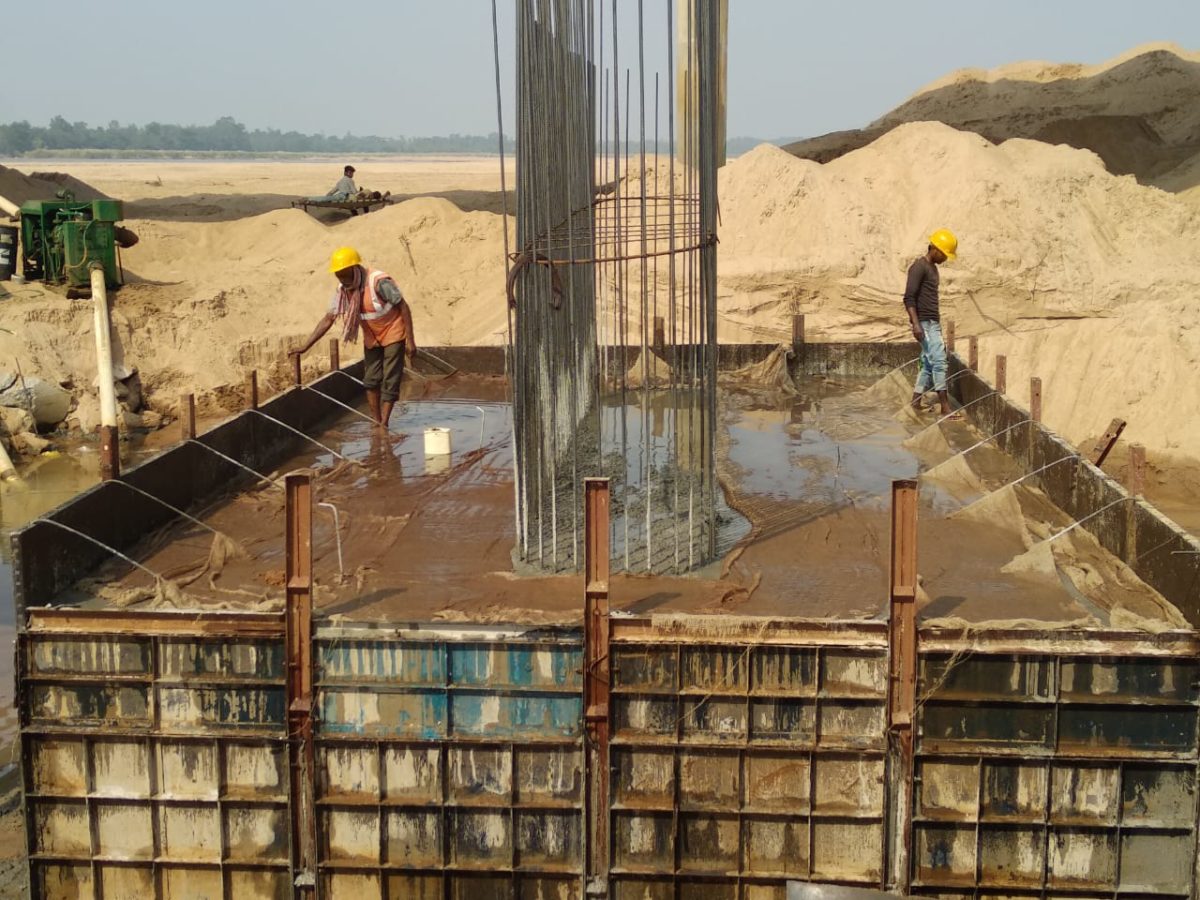
METHOD STATEMENT OF PILE CAP

A pile cap is a thick concrete foundation rest on concrete or timber piles that have been driven into soft or unstable ground to provide a stable foundation. It usually forms part of the foundation of a building or structure or it is the uppermost portion of a pile which acts to secure the piles in position and receive and distribute superstructure loads.

In this article we will discuss the method statement of pile cap in detail  with the help of following section:

  1. Equipment
  2. Procedure
  3. Safety

1.EQUIPMENT

  1. Excavator
  2. Dumpers
  3. Batching Plant
  4. Transit Mixers
  5. Truck / trailer
  6. Welding Generator
  7. Concrete Vibrators
  8. Concrete Needles
  9. Jack hammer
  10. Compressor
  11. Crane / Hydra
  12. De-watering Pump

* As per site condition above mentioned equipment can be increased or decreased.

2.Procedure

a.SURVEY:

Before commencing excavation, the pile cap area shall be marked on the ground after carrying out survey with reference to control points. After excavation the levels of the pit shall be checked for correctness to the drawings and recorded. Longitudinal and transverse centerlines shall be marked outside the pit for reference for cross checking the pile. The shift of pile shall be recorded by marking the theoretical co­ordinates of pile on ground and circle of equivalent to pile diameter shall be drawn and shift of actual pile will be measured from theoretical edges of pile. The as built details of the piles shall be recorded jointly. Based on shifted location of pile top, pile Cap / P.C.C. layout shall be marked to ensure minimum 150 mm offset from outer edge of pile. After laying of PCC, the layout of the pile cap shall be marked on it with reference to the reference points to facilitate tying of rebar and erection of shuttering.

b.EXCAVATION:

Shoring shall be provided depending upon the stability of the soil found in the area. Shoring shall be done with the help of old steel plates and props. At road locations the pit shall be excavated to the dimensions providing working space all around the pile cap, to facilitate fixing of steel & erection of shuttering as detailed in the drawings. The last 300 mm excavation shall be carried out manually & leveling course shall be laid down within 36 hrs after completing excavation of last 200 mm depth. Provision for sump shall be made at the comer of the pit to pump out underground water of about 750 mm deep from PCC bottom. Also an earthen drain of about 200 mm width if required shall be provided all around pile cap dimension & it shall be connected with sump to drain off excess rain water/seepage water to ensure that the water table will at least 300 mm below the lowest level of the excavation before laying PCC. The excavated earth shall be then disposed by means of trucks / loaders.

c.REMOVAL OF LAITANCE:

After excavation the laitance of the piles shall be removed by using Pneumatic Jack Hammers seven days after casting of pile or manually three days after casting of pile. The top of pile after striping shall project 50 mm into the pile cap and reinforcements of pile shall be fully anchored in pile cap as per clause 709.5.2 of IRC: 78:2000. The debris of broken concrete shall be removed from the pit and disposed off to approve dumping sites. Exposed bars shall be straightened & cleaned properly with wire brush.

d. PCC:

After leveling the bottom of the bed, sprinkle some water to keep the soil moist. PCC of Mix M15 or specified in drawing shall be mixed at the centralized batching plant at the casting yard and transported to site in transit mixers. The concrete shall directly pour through chutes from three locations, shall be spread and leveled manually to the specified thickness shown in the drawing. PCC edges shall be projected 100 mm more than that of pile cap as detailed in the drawing to facilitate the fixing of form work and levels of PCC shall be jointly checked & verified. The PCC shall be cured by sprinkling water.

e.REINFORCEMENT

a) Fabrication: For fabrication of reinforcement, BBS shall be prepared as per the “Good for Construction” drawings. The Reinforcement shall be cut using cutting machines or manually as required and bent at Rebar yard. The re-bars shall either be transported to location in trailer / truck or cutting bending may be done at site depending upon the situation.

b) Fixing of Re-bars:

The re-bars shall be manually fixed into its position as shown in the good for construction drawing. Reinforcement of pile cap shall be lapped with the reinforcement of pile. Cover blocks of same grade of concrete in which these are to be embedded shall be provided at spacing of about 2.0 m c/c to ensure uniform cover as specified in the drawing and tied together with GI binding wire. After fixing the pile cap rebar, pier shaft rebar shall be erected. This rebar shall be supported by erecting a suitable staging frame across the width of the pile cap. The rebar cage shall be checked as per checklist given in QA manual and RFI for inspection shall be raised with IE. The rebar, chairs, spacers & laps shall be jointly checked after completion of cage placing. Sufficient chairs and spacers shall be provided to keep the cage in its proper position. After getting the clearance, balance shuttering work will be taken up. Pier dowels shall be hold in position rigidly to prevent it from buckling.

f.SHUTTERING

Shuttering fabricated as per approved drawings shall be placed at locations as per the pile cap dimensions shown in the good for construction drawing. Reinforcement shall be fixed as per the drawing and marking the layout on PCC for pile cap. After completing the fixing of rebar cage shuttering shall be erected & fixed on the layout drawn on PCC. Before fixing, the shuttering area shall be cleaned with wire brush & approved shuttering oil shall be applied on concrete face. After fixing of shuttering it shall be checked as per QA checklist and RFI to be raised for inspection of IE. For preventing leakages from joints, rubber strip/foam strip shall be provided at the joints of shuttering plates. Proper side supports/bracings/tie bars shall be provided to resist lateral pressure of green concrete during pouring.

g.CONCRETING

The required (M-35) grade concrete shall be produced as per the approved concrete design mix from the centralized batching plant and transported by transit mixers to the pouring location. Before pouring concrete, slump of 80 mm to 130 mm shall be checked at pouring location. The concrete shall be placed by concrete pump /placer boom or by direct chutes. Concrete placing commences from one end to another in cascading manner till completion. The drop height of the concrete should not be more than 1.5 m. The concrete shall be vibrated using 60 mm / 40 mm diameter needle vibrators. Concrete cubes shall be taken for testing of compressive strength as per IRC 21 at pouring location. Concreting should be done in such a way that next layer of concrete should be laid before initial set of concrete of previous layer to avoid cold joints. Regular tamping shall be done during & after concreting operation.

h.CURING

 Date of concrete shall be written on the concrete surface to ensure curing up to the specified   duration after date of casting.

The concrete shall be cured by ponding method. Bunds of cement mortar of lean mix shall be built after the concrete attains final setting time after casting of concrete, these bunds shall be filled with water from approved source. The sides of the pile cap shall be covered with Hessian cloth till back filling is started. Further curing is ensured by keeping the backfill moist with water.

i. BACKFILLING

Immediately after de-shuttering, concrete surface shall be checked jointly and get the approval for backfilling. Back filling with local earth available or excavated material shall be carried out in layers of 250 mm (compacted thickness).(as per MORT&H clause no – 304.3.7)

The compaction shall be done with the help of suitable equipment such as rammer or plate vibrator etc., after necessary watering, so as to achieve a density not less than required  field density .

j.MISCELLANEOUS WORKS

After backfilling the damaged roads, if any shall be repaired immediately preferably within 15 days of backfilling as per specification before removing of the barricades, the whole area shall be cleaned after completion of work.

  1. SAFETY:- All safety precautions shall be taken as per safety manual submitted by us. Further the preparatory works shall also be carried out as per Diversion plans separately submitted for construction activities on urban areas.

1.A width of approx.8.00 m (outside to outside of barricading) shall be barricaded along road for purposes of construction of pile caps. This can be increased at specific location with prior approval of Engineer.

2.Suitable reflectors, blinkers, diversion board, painting of barricade etc. shall be done to caution the road users and for their safety. Working space shall be well illuminated during work at night.

3.All site personnel shall wear helmets, safety shoes and other safety devices as required.

4. Proper precautions and safety arrangements shall be used for activities like welding, handling of reinforcement, fixing of formwork, electrically operated equipment etc.

Facebooktwitterredditpinterestlinkedinmail

WHAT IS 90th PERCENTILE CBR

The kth percentile is a value in a data set that splits the data into two pieces: If lower piece contains k percent of the data, then upper piece contains the rest of the data means (100 – k) percent, because the total amount of data percentage is 100% where  k is any number between 0 and 100 & median will the 50th percentile.

PROCEDURE
1. First of all arrange all values from smallest to largest.
2. Mulitiply the 90 percent with total number of data if multiplied product is not whole number, round them.
3. Rounding number will be the test data.(Smallest to largest) suppose it is 5
4. Then you go until you find the 5th value in the data set . This value will be 90th percentile. Lets take an example ,suppose 4 days soaked CBR for 10 test in percentage is 15.86,10.32,19.08,11.87,23.84,18.73,16.74,18.15,17.27 & 19.32
then simplified solution can be determined as below :

step 1. First arrange with smallest to largest value it will be
10.32, 11.87, 15.86, 16.74,17.27,18.15,18.73,19.08,19.32,23.84
Step 2. Multiply 10 by 90% i.e 10 x .09 = 9
Step 3. Counting from left to right (from the smallest to the largest value in the above CBR set), you go until you find the 9th value in the step 2 data sheet & this value is 19.32, and it’s the 90th percentile for this data set.

Facebooktwitterredditpinterestlinkedinmail